

Hanging seasonal lights along a roofline can be done safely, but the safest approach is usually to decorate from a ladder or from ground level rather than walking on the roof. Falls, electrical shock, damaged shingles, and hidden winter hazards are the main concerns.
In Ithaca, NY, cold temperatures, wet surfaces, snow, ice, and early darkness can make an otherwise simple decorating project more hazardous than it appears. Planning the layout before climbing is often the most effective safety measure.
Is it safe to walk on a roof to hang lights?
Usually, no. Walking on a roof creates fall and surface-damage risks, especially when shingles are damp, frosty, icy, or covered with leaves. Asphalt shingles can also lose protective granules or become brittle in cold weather.
Avoid stepping onto the roof if:
- The roof is wet, icy, snow-covered, steep, or unusually high.
- Wind makes the ladder or light strands difficult to control.
- The roof has moss, loose shingles, skylights, fragile roofing materials, or exposed edges.
- There is no properly installed fall-protection equipment.
- You would need to stretch, lean, or work near an unprotected roof edge.
For many one-story homes, lights can be attached to the fascia, eaves, gutters, or siding while standing on a properly positioned ladder. If the design requires walking across the roof or working near a steep edge, the task has moved beyond a routine decorating project and should not be attempted without appropriate fall protection and training.
What should be checked before hanging lights?
Inspect both the roof edge and the lighting equipment before installation. Do not wait until a ladder is already in place to discover a loose gutter or damaged cord.
Look for:
- Loose or sagging gutters and downspouts.
- Cracked, lifted, or missing shingles near the eaves.
- Rotting fascia boards or loose trim.
- Branches that could rub against the lights or fall during wind.
- Overhead electrical lines near the work area.
- Cracked sockets, exposed wire, frayed insulation, or bent plug blades.
- Outdoor lights and extension cords that are not clearly rated for exterior use.
Damaged light strands should be discarded rather than taped and reused. Tape may hide a problem temporarily but does not restore the cord’s insulation or electrical protection.
Choose lights that have been tested by a recognized safety laboratory and follow the manufacturer’s instructions for outdoor use. Outdoor-rated does not mean waterproof under every condition, so connections should still be kept away from standing water and positioned where snow and ice are less likely to collect.
What is the safest way to use a ladder?
A ladder should be placed on firm, level ground and inspected before use. Do not set it on snow, ice, loose gravel, a porch railing, a box, or another ladder to gain extra height.
Use these precautions:
- Keep the ladder away from overhead service lines and other electrical conductors.
- Face the ladder while climbing and keep both hands available whenever possible.
- Maintain three points of contact as you move.
- Do not stand on the top cap or the highest prohibited step.
- Keep your belt buckle between the ladder’s side rails instead of leaning sideways.
- Have another adult steady the ladder when conditions are uneven or the work area is exposed.
- Move the ladder rather than reaching several feet beyond its side.
- Keep tools in a belt or bucket instead of carrying them while climbing.
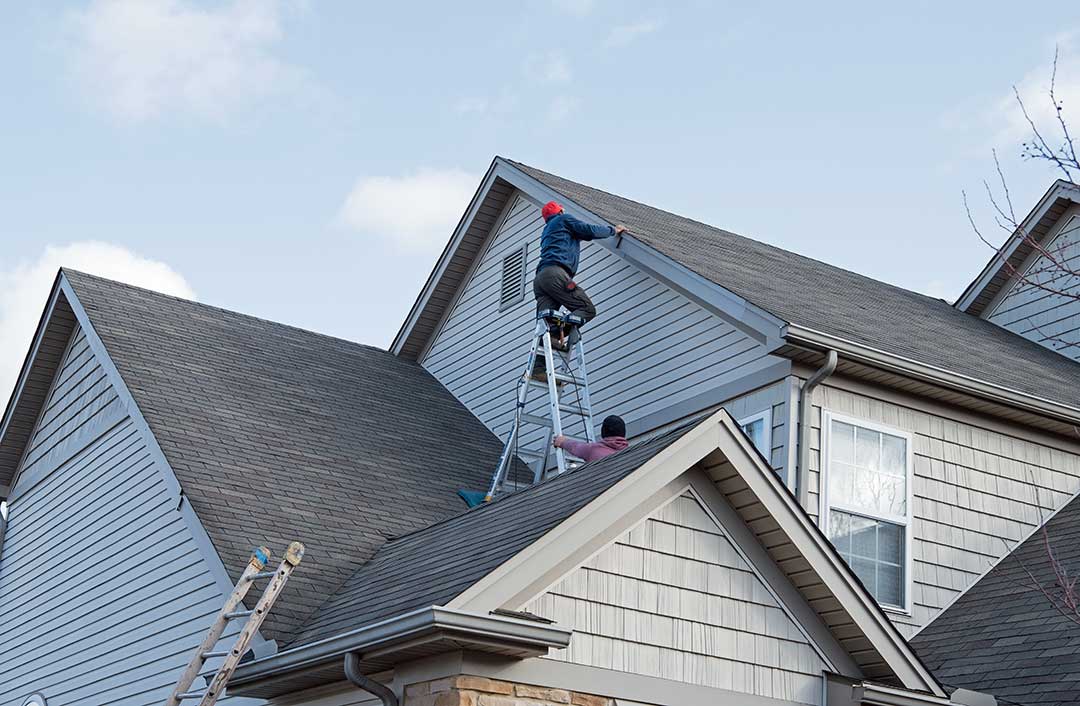
For a two-story roofline, a ladder may not provide a safe working position. A taller ladder does not solve every access problem, particularly where the ground slopes or the upper roof edge is difficult to reach.
How should lights be attached to the roofline?
Use purpose-made clips that fit the light strand and the location where it will be installed. Clips may attach to gutters, shingles, fascia, or eaves, but the package instructions should identify the intended surface.
Do not use nails, staples, screws, or improvised fasteners through the wire. Puncturing the insulation can create an electrical hazard, and fasteners can damage flashing, shingles, fascia, or gutter components.
Avoid placing weight on the narrow edge of shingles. A clip that slides under a shingle can disturb the weather seal, especially if it is forced into place or removed roughly. Never lift shingles aggressively to insert a decoration.
The light strand should hang with a small amount of slack. It should not be pulled tight, pinched under a gutter, caught in a downspout, or allowed to rest against sharp metal edges. Leave room for normal movement from wind and temperature changes.
At corners, use gradual curves rather than sharp bends. Keep cords away from areas where ice commonly forms, including valley edges, downspout outlets, and locations beneath roof runoff.
How can electrical risks be reduced?
Outdoor lighting should be connected to an outdoor receptacle protected by ground-fault circuit-interrupter protection, commonly called GFCI protection. This device can shut off power quickly if electricity takes an unintended path through water or a person.
Use outdoor-rated extension cords that are long enough for the layout. Avoid connecting multiple extension cords end to end, and do not overload a receptacle or power strip. Follow the light manufacturer’s limit for the number of strands that may be connected together.
Keep plug connections elevated and protected from puddles, melting snow, and direct runoff. A loose connection lying on the ground can become a hazard even when the lights themselves are rated for outdoor use. Do not run cords where they can be pinched in a window or door, crossed by a walkway, or damaged by a snow shovel.
If the GFCI trips repeatedly, unplug the display and investigate. Repeated tripping may indicate water intrusion, damaged equipment, an overloaded circuit, or a wiring problem. Resetting the device over and over without finding the cause is not a safe solution.
Should lights remain on overnight?
Lights should be turned off before going to sleep or leaving the home. A timer designed for outdoor use can reduce the chance of forgetting, provided the timer and receptacle are suitable for the electrical load and weather conditions.
After snow, freezing rain, or strong wind, inspect the display from the ground. Look for sagging strands, fallen branches, iced-over connections, damaged clips, and lights pulled toward the roof edge. Do not climb onto an icy roof to make a repair.
When should roof lighting be avoided entirely?
Skip roofline installation when conditions are wet, icy, snowy, windy, or poorly lit. Also avoid the project if the roof edge, ladder base, or electrical connection cannot be reached without unsafe stretching or roof access.
Ground-level decorations, window lighting installed from inside, or lights attached to sturdy porch structures can provide a similar effect with less exposure to falls. If electrical equipment is damaged, the roof structure is unstable, or safe access cannot be established, the hazard is more significant than the decoration is worth.
