
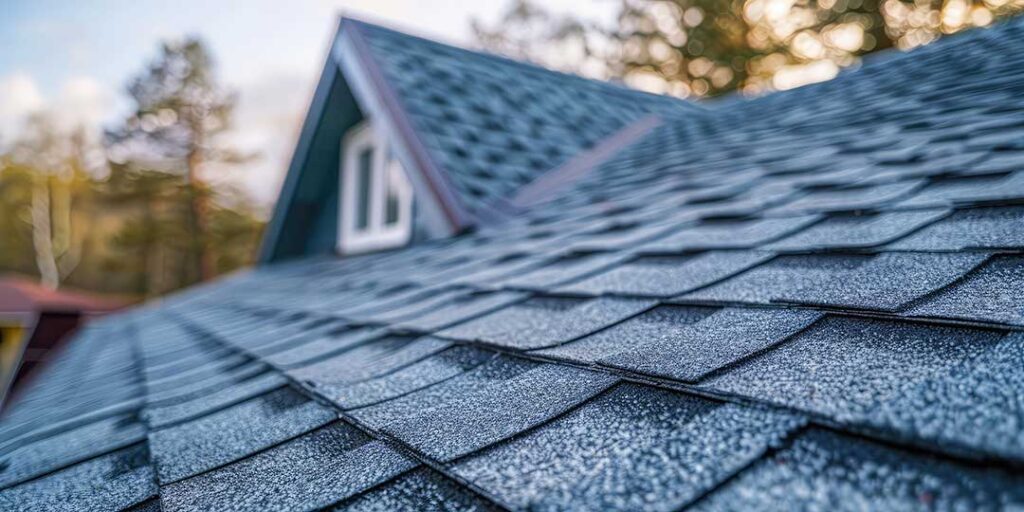
Hail damage is not always obvious from the ground. On a roof, the most useful clues are small dents, missing granules, bruised roofing materials, and damage to exposed metal or outdoor property. A careful inspection after a severe storm can help determine whether the roof may need attention before minor defects contribute to leaks.
What does hail damage usually look like?
Hail damage often appears as small, irregular impact marks rather than large, dramatic holes. On asphalt shingles, the affected areas may look darker, flatter, or slightly depressed. Granules may be missing, exposing the darker asphalt coating beneath.
Common signs include:
- Circular or irregular dents in shingles
- Areas where roof granules have been knocked loose
- Cracked, split, or fractured shingle surfaces
- Exposed fiberglass matting beneath the shingle coating
- Bruising that feels soft or slightly spongy
- Bent or dented metal flashing, vents, gutters, or downspouts
- Damaged siding, window screens, deck surfaces, or outdoor equipment
A roof does not need to have visible holes to be affected. Repeated impacts can weaken the shingle surface and shorten its service life even when water is not entering the home immediately.
Where should a homeowner look first?
Begin with the ground-level areas around the house. Damage to other surfaces can provide useful evidence that hail reached the roof with enough force to cause harm.
Inspect:
- Window screens and exterior trim
- Siding, especially on exposed walls
- Gutters and downspouts
- Air-conditioning equipment
- Decking, railings, and outdoor furniture
- Garden sheds or other small structures
- Vehicles parked outside during the storm
Hail damage is often more noticeable on softer materials, such as vinyl siding or painted metal, than on shingles. If several exposed surfaces show fresh dents from the same storm, the roof deserves a closer visual review.
Roof slopes facing the direction of the storm may receive more impact than sheltered slopes. However, hail can bounce, shift direction in strong wind, and affect more than one side of a roof. Damage should not be ruled out simply because one slope appears unaffected.
How can hail damage be distinguished from normal roof aging?
Normal aging usually affects broad areas gradually. Hail damage is more likely to appear as concentrated, localized impact marks.
Weathered shingles may show:
- General fading or discoloration
- Widespread granule loss in roof valleys and gutters
- Curling or lifting along many shingle edges
- Brittleness across much of the roof surface
- Uniform deterioration on several roof slopes
Hail damage is more likely when there are distinct dents, fresh-looking exposed spots, or scattered areas of bruising surrounded by otherwise intact shingles. The pattern may be random because each mark represents a separate impact.
Granules in gutters do not automatically prove hail damage. Some granule loss is expected as shingles age, especially near roof edges and drainage areas. A sudden increase in granules after a major storm is more meaningful when it occurs along with dents or damaged exterior surfaces.
Can hail damage be seen from the attic?
Sometimes, but attic inspection is not a substitute for examining the roof surface. Hail may damage shingles without creating an immediate opening through the roof deck.
From inside the attic, look for:
- Damp insulation
- Water stains on rafters or roof decking
- Fresh discoloration
- Dripping or wet areas after rainfall
- Daylight visible through the roof assembly
- Musty odors or localized moisture
Water stains may come from older leaks, condensation, ice-related problems, or plumbing penetrations rather than hail. A stain that appears after a recent storm is worth documenting, but its cause should not be assumed based on timing alone.
In Ithaca, NY, changing weather can make roof conditions harder to interpret. Heavy rain may follow a hailstorm, while freeze-thaw cycles later expose weaknesses that were not immediately visible. Moisture problems may therefore become noticeable days or weeks after the original event.
Is it safe to inspect the roof personally?
A ground-level inspection is generally safer and often provides useful information. Walking on the roof is riskier, particularly when shingles are wet, steep, brittle, moss-covered, or difficult to access.
Do not climb onto a roof during or immediately after a storm. Ladders, wet surfaces, loose materials, and overhead hazards can create serious fall risks. Snow, ice, and damp leaves add additional danger during colder months.
If a close inspection is necessary, safety may require someone with appropriate equipment and training. This is especially true for multistory homes, steep roofs, or properties with limited ladder access. Residents should also avoid probing suspected damage with tools because aggressive handling can create new defects.

What roof materials can be damaged by hail?
Asphalt shingles are common, but hail can affect many roofing systems.
- Asphalt shingles: May develop bruised areas, cracks, exposed matting, and missing granules.
- Wood shakes: Can split, fracture, or show fresh impact marks.
- Metal roofing: May develop dents, scraped coatings, or damaged seams, although a dent does not always affect watertightness.
- Membrane roofing: Can suffer punctures, cuts, or weakened seams.
- Flat roof coverings: May show localized depressions, punctures, or displaced surface materials.
The meaning of a mark depends on the material. A shallow dent in metal is not automatically a leak, while a small puncture in a membrane roof may require prompt attention. Roofing materials should be evaluated according to their design and condition rather than by appearance alone.
What should be documented after a hailstorm?
Photographs are most useful when they show both the overall roof area and close details. Take pictures from the ground first, then photograph accessible exterior surfaces without creating a safety risk.
Record:
- The date and approximate time of the storm
- The location of visible damage
- Close-up and wide-angle photographs
- The condition of gutters, vents, siding, and screens
- Any interior staining or moisture
- Changes noticed after later rainfall
Avoid cleaning up damaged materials before documenting them when possible. Keep loose shingle pieces or broken exterior items in a safe location if they may help establish what occurred. Weather observations, including hail size and storm timing, can also be useful for household records.
When does hail damage require prompt attention?
Prompt attention is warranted when water is entering the home, roof materials are visibly missing, a roof opening is exposed, or flashing and vents are badly damaged. Wet insulation, active dripping, and expanding ceiling stains should be treated as urgent maintenance concerns.
A roof may still need evaluation even without an active leak if there are numerous impact marks, exposed underlayment, broken shingles, or significant granule loss. Delayed damage can become more serious after wind, rain, snow, and repeated freezing and thawing.
Hail damage does not always mean that the entire roof needs replacement. The appropriate response depends on the type of material, the number and location of damaged areas, the roof’s age, prior wear, and whether the underlying layers remain watertight.
What are common misconceptions about hail damage?
A few assumptions frequently lead to confusion:
- “There must be a leak for hail damage to exist.” Small impacts can weaken roofing materials without causing immediate interior moisture.
- “Every dent is proof of serious damage.” Some dents are cosmetic, especially on certain metal components.
- “Only large hail causes roof damage.” Wind-driven or repeated smaller impacts can also affect vulnerable materials.
- “A few granules in the gutter prove hail damage.” Granule loss has several possible causes.
- “If one roof slope looks fine, the whole roof is fine.” Storm direction, wind, and roof geometry can create uneven damage.
- “Older roofs cannot be damaged by hail.” Older materials may be more vulnerable, but visible storm-related impacts still need to be distinguished from ordinary aging.
A careful assessment looks at the complete pattern: the storm conditions, roof material, age, visible impact marks, surrounding property, and any signs of moisture inside the home.
